GOVERNMENT POLYTECHNIC, ADITYAPUR

    Approved by AICTE, New Delhi, DHTE, Govt. of Jharkhand & Affiliated to JUT Ranchi

Home Academics Departments Electrical Engineering

Department of Electrical Engineering

Established in the year 2000, the Department of Electrical Engineering has been dedicated to imparting high-quality technical education, equipping students with the skills and knowledge necessary to excel in the dynamic field of electrical engineering. With a strong focus on innovation, practical skills, and industry-relevant training, the department has been a pioneer in shaping skilled professionals in the electrical engineering domain.

The department offers a 3-Year Diploma in Electrical Engineering, which provides a strong foundation in electrical systems, power distribution, electronics, and control systems. The curriculum is designed to provide students with the necessary theoretical knowledge, practical skills, and critical thinking abilities to meet the challenges of modern electrical engineering.

Our faculty, state-of-the-art laboratories, and industry collaborations ensure that our students are well-prepared for careers in industries such as power generation, electronics, telecommunications, automation, and renewable energy.


Computer Science & Engineering Department
Vision Icon

Vision

To be a globally recognized center of excellence in Electrical Engineering education, fostering innovation and developing competent professionals who can lead in the rapidly evolving field of electrical technologies.
Mission Icon

Mission

  • To provide high-quality education in Electrical Engineering by combining theoretical knowledge with practical skills, and encouraging innovation and problem-solving.
  • To promote hands-on learning through state-of-the-art laboratories and exposure to real-world industry practices.
  • To develop ethical and professional engineers who can effectively address global challenges in energy, automation, and sustainable technologies.
  • To encourage continuous learning by providing a platform for students to engage with advanced topics and participate in research, internships, and industry collaborations.

Program Specific Outcomes (PSOs)

Upon successful completion of the Diploma in Electrical Engineering, students will be able to:

  • PSO1 – Electrical System Design and Analysis: Apply the principles of electrical engineering to design, analyze, and troubleshoot electrical circuits, power systems, and equipment in real-world applications.
  • PSO2 – Hands-on Skills and Practical Knowledge: Demonstrate proficiency in the use of modern electrical instruments, tools, and software for testing, simulation, and operation of electrical systems.
  • PSO3 – Power Generation and Distribution Expertise: Understand and work with electrical power generation, distribution, and transmission systems, ensuring the efficient and sustainable use of energy.
  • PSO4 – Problem-Solving and Innovation: Utilize analytical thinking and creative problem-solving skills to develop innovative solutions to electrical engineering problems, contributing to the advancement of the field.

Program Educational Objectives (PEOs)

The Diploma in Electrical Engineering program aims to produce professionals who will:

  • PEO1 – Core Knowledge and Engineering Skills: Develop a strong understanding of electrical engineering principles, allowing them to effectively solve complex problems in various sectors, including power systems, electronics, and automation.
  • PEO2 – Industry-Ready Professionals: Equip students with practical and industry-specific skills, preparing them for immediate employment in the electrical engineering field or for pursuing higher education.
  • PEO3 – Ethical, Sustainable, and Innovative Engineering Solutions: : Encourage graduates to work with a strong sense of ethical responsibility and contribute towards sustainable energy solutions, innovation, and technological advancements.
  • PEO4 – Lifelong Learning and Leadership: Promote lifelong learning habits and leadership qualities, enabling graduates to adapt to technological changes and take on leadership roles in their careers.

Electrical Engineering Laboratories

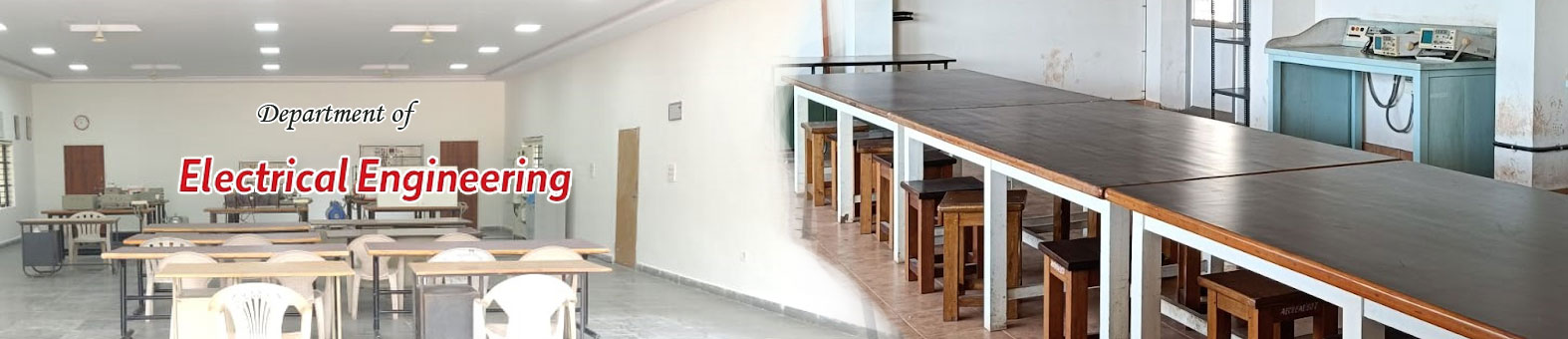
The Electrical Engineering Department is equipped with modern and well-maintained laboratories that provide students with the practical knowledge and hands-on experience required in the field. Some of the key laboratories are:


  • Electrical Machines Lab: This lab is equipped with various electrical machines such as transformers, induction motors, and synchronous machines. Students gain experience in understanding machine operation, performance testing, and fault diagnosis.
  • Power Systems Lab: The Power Systems Lab allows students to study and experiment with various components of electrical power systems, including circuit breakers, transformers, and protection systems. It is designed to simulate real-world scenarios in power generation, transmission, and distribution.
  • Control Systems Lab: In this lab, students learn about the control and automation of electrical systems. The lab includes setups for designing and testing different control systems, including PID controllers, PLCs (Programmable Logic Controllers), and SCADA systems.
  • Electronics Lab: The Electronics Lab is equipped with components and instruments for designing, testing, and troubleshooting analog and digital circuits. Students explore circuit theory, amplifiers, oscillators, and microelectronics.
  • Renewable Energy Lab: With the growing importance of sustainable energy, the Renewable Energy Lab provides practical exposure to systems such as solar power, wind energy, and energy storage. Students work on simulations, setups, and performance analysis of renewable energy systems.
  • Instrumentation and Measurement Lab: This lab focuses on the principles of measurement and instrumentation, offering hands-on experience with various electrical measurement devices like oscilloscopes, multi-meters, and signal generators, essential for precise data acquisition and system analysis.
  • Automation Lab: The Automation Lab offers hands-on training in industrial automation technologies, including advanced PLC programming, HMI development, robotic control systems, and integration with sensor networks and actuators.
  • CAD Lab: The Computer-Aided Design (CAD) Lab equips students with the skills to design and simulate electrical circuits and systems using industry-standard software such as AutoCAD, MATLAB/Simulink, and ETAP. It emphasizes schematic design, layout planning, and system-level simulation.

Top Recruiters of GPA

Aditya Birla Jindal Steel JSW Steel L&T RKFL Tata Power Viraj Steel Evision CEAT Infaya Apollo Tyres Layam Narsingh Ispat